
The Best Team Building Escape Rooms for Beginners

Your First Step into Adventure
Team building escape room experiences are interactive games where your group is "locked" in a themed room and has 60 minutes to solve puzzles, find clues, and work together to escape. Here's what makes them perfect for beginners:
- No special skills required - just problem-solving and teamwork
- Game masters provide hints when you're stuck
- Themes range from mysteries to heists to match your team's interests
- Group sizes typically 4-8 people for optimal collaboration
- Success rates are balanced so beginners can win with good teamwork
Think of it like putting your team in the middle of an adventure movie. You'll face a series of challenges that no single person can solve alone. Some team members might excel at spotting hidden clues, while others shine at connecting the dots between puzzles. The time pressure creates just enough urgency to spark creativity without overwhelming anyone.
Research shows that 90% of employers agree that creating a sense of community in the workplace contributes to the success of a company. Escape rooms deliver on this naturally—they force communication, reveal hidden strengths in team members, and create shared memories that last long after the game ends.
Whether you're looking to strengthen bonds among new employees, boost morale in an established team, or simply replace another boring trust fall exercise, escape rooms offer something genuinely different. They're challenging enough to feel rewarding but designed so beginners can succeed with good teamwork and communication.
I'm James Bernard, and I've spent over two decades creating immersive experiences. At Alcatraz Escape Games in Utah, I've watched thousands of teams find that the best team building escape room experiences aren't just about escaping—they're about what your team learns about each other along the way.
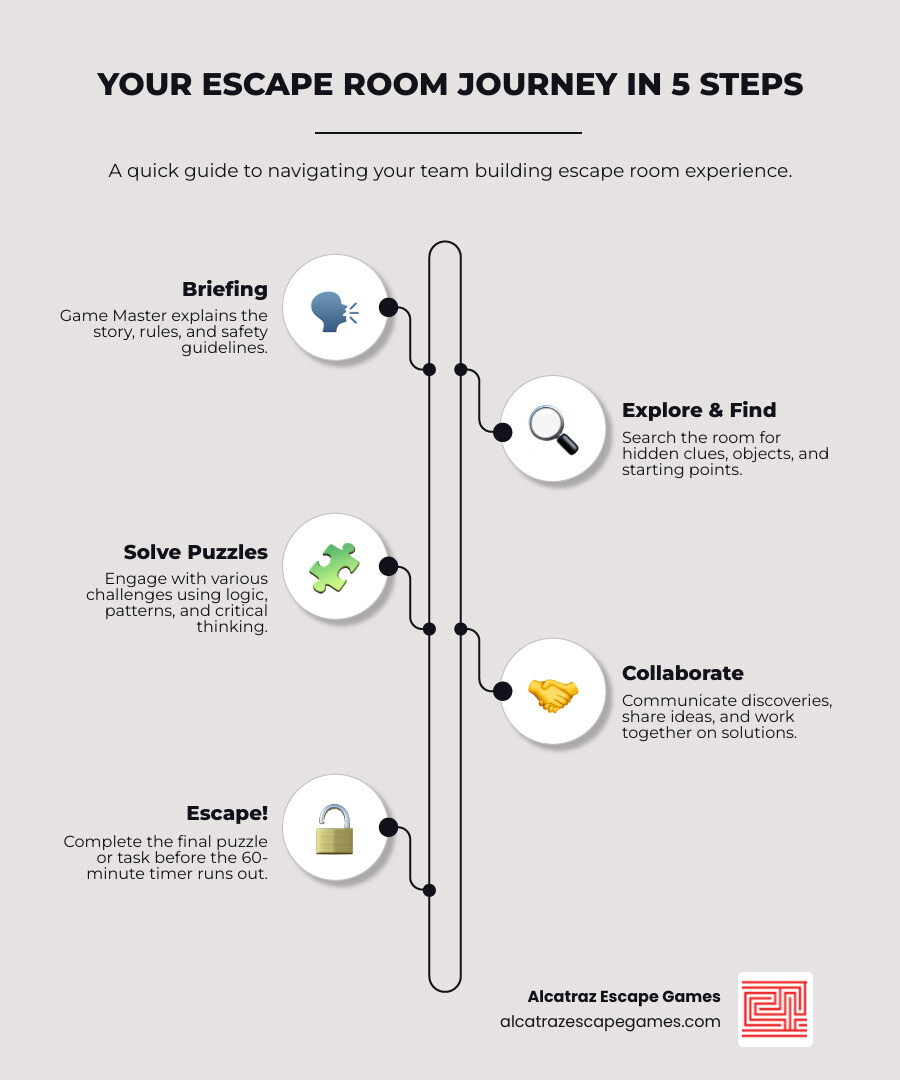
Team building escape room terms to learn:
Why Escape Rooms are the Ultimate Team Building Tool
Let's be honest—most team-building activities feel like chores dressed up as fun. Trust falls. Icebreaker games that make everyone cringe. Another round of "two truths and a lie" that nobody asked for.
But here's the thing: a team building escape room doesn't feel like team building at all. It feels like an adventure. And that's exactly why it works so well.
When your team walks into one of our themed rooms at Alcatraz Escape Games, something remarkable happens. The artificial pressure of a 60-minute countdown creates real stakes—not career-ending stakes, but enough urgency to strip away the usual workplace dynamics. Suddenly, the quiet analyst is spotting patterns nobody else sees. The intern who's been with you three weeks solves the puzzle that stumped your senior manager. Collaboration stops being a buzzword on a motivational poster and becomes the only way forward.
Unlike those forced trust exercises, escape rooms make teamwork inevitable. No single person can solve all the puzzles—we literally design them that way. One team member might excel at finding hidden objects while another connects seemingly unrelated clues. This natural division of labor happens organically, without anyone assigning roles or making it awkward.
Communication becomes critical the moment that timer starts. Your team quickly learns that hoarding information doesn't work. The person examining a locked box needs to know about the three-digit code someone else just finded across the room. Quieter team members find their voice because their observations genuinely matter. We've watched countless teams find that their newest or shyest members often spot things everyone else missed.
The problem-solving and critical thinking that happens in an escape room mirrors real workplace challenges—just way more fun. Your team faces logic puzzles, pattern recognition, ciphers, and physical tasks that require thinking differently. When the first approach doesn't work, they adapt. When someone's stuck, others jump in with fresh perspectives. It's like a pressure-test for your team's collective brain, except everyone's actually enjoying it.
And here's what really matters: 90% of employers agree that fostering a sense of community is crucial for company success. Escape rooms naturally build this community. When your team solves that final puzzle with thirty seconds left, the celebration is genuine. High-fives all around. Shared triumph. These moments boost employee morale in ways that last far beyond the game itself.
Research shows that having a best friend at work significantly improves the employee experience. The shared intensity of an escape room—the laughter when someone tries a ridiculous solution, the collective "aha!" moment when everything clicks—creates exactly these kinds of bonds. You're not forcing friendships; you're creating the conditions where they naturally develop.
There's also something to be said for workplace wellness and stress reduction. Engaging your brain in a fun challenge provides a genuine mental break from work routines. It's an hour where nobody's checking email, nobody's in a meeting, and everyone's focused on something completely different. Teams leave feeling energized rather than drained, which is more than you can say for most corporate events.
The shared memories your team creates matter more than you might think. Six months from now, nobody will remember another conference room meeting. But they'll absolutely remember the time Sarah figured out the hieroglyphics, or when the whole team was searching frantically for that last key with two minutes remaining. These stories get retold. They become part of your team's culture.

Choosing Your First Team Building Escape Room Adventure
Picking the right room for your team's first escape adventure can feel overwhelming—there are so many themes, difficulty levels, and options to consider. But here's the good news: with a little guidance, you'll find the perfect fit that gets everyone excited and engaged.
The key is starting with a theme that sparks your team's imagination and choosing a difficulty level that challenges without frustrating. Let's walk through what works best for first-timers.
Popular Themes for a Beginner Team Building Escape Room
The theme you choose sets the entire mood for your adventure. It's the difference between your team investigating a murder mystery or pulling off a daring heist. For beginners, certain themes tend to hit that sweet spot—exciting enough to be memorable, but accessible enough that everyone can jump in without feeling lost.
Mystery and Detective rooms are perfect if your team loves solving puzzles through observation and logic. You might be tracking down a serial killer, recovering a stolen artifact, or uncovering a decades-old secret. These rooms reward teams who communicate well about what they're finding and can piece together clues from different corners of the room.
If your team craves a bit more adrenaline, Heist and Bank Robbery themes deliver that rush. There's something universally thrilling about cracking a safe or outsmarting security systems (in a completely legal way, of course!). These rooms often mix mental puzzles with physical challenges like manipulating locks or coordinating timed actions across the team.
Prison Break scenarios tap into that primal urge to escape. The ticking clock feels especially real when you're "locked" in a cell. These themes are fantastic for building urgency and forcing creative thinking—after all, you'll need to outsmart the guards and find hidden passages to earn your freedom.
For teams who want a grand adventure, Adventure and Treasure Hunt themes offer rich storytelling and varied puzzles. Imagine deciphering ancient maps, solving riddles left by explorers, or navigating through a lost temple. The narrative sweep of these rooms helps everyone feel like they're part of something epic.
Sci-Fi and Mad Scientist rooms appeal to teams who enjoy futuristic settings or quirky scenarios. Maybe you're stopping a rogue AI, preventing a scientific catastrophe, or escaping from a laboratory where experiments have gone terribly wrong. The puzzles can range from technological challenges to wonderfully weird logic problems.
The theme you choose matters more than you might think. When your team is genuinely interested in the story, they'll naturally engage more deeply with the puzzles. That's why we believe unlocking team potential with these escape rooms team building experiences starts with finding a narrative that resonates with your group's interests.
In-Person Escape Rooms at Alcatraz Escape Games
We're proud of what we've built here in Utah, with locations in both Draper and Lindon. Our physical escape rooms offer something you simply can't replicate through a screen—the tactile thrill of actually opening a hidden compartment, the immersive detail of themed environments, and the energy that comes from your team physically working together in the same space.
| Benefit | What It Means for Your Team |
|---|---|
| Tactile and Immersive | Your team actually handles props, opens locks, and finds hidden compartments. The physical interaction makes every findy more satisfying and memorable. |
| Designed for All Levels | Our themed rooms work beautifully for first-timers and experienced players alike. We've carefully balanced challenge with accessibility. |
| Perfect for Local Teams | If you're in Utah, you can gather your whole team in one place for a team building escape room experience that builds real connections. |
| Ideal for Corporate Events | We understand the unique needs of corporate groups and can accommodate teams of various sizes with private bookings and multiple rooms. |
There's something special about watching your team celebrate together when they solve a particularly tricky puzzle—the high-fives, the laughter, the shared sense of accomplishment. That's what in-person experiences deliver.
Choosing the Right Difficulty
Here's a secret: for your first team building escape room, you want to aim for an experience where your team feels challenged but ultimately successful. Nothing kills team morale faster than an escape room that's so difficult everyone leaves frustrated.
That's why we always recommend starting with our beginner-friendly rooms. These are specifically designed to introduce teams to escape room mechanics without overwhelming them. The puzzles are clever and satisfying to solve, but they won't require obscure knowledge or frustrating leaps of logic.
The beauty of starting at the right difficulty level is that your team builds confidence and learns how to work together effectively. Then, when they're ready for more challenge, they'll have the skills and communication patterns to tackle our more advanced rooms.
Don't hesitate to ask us for recommendations when you book. We've seen thousands of teams come through our doors, and we've gotten pretty good at matching groups with the perfect room for their experience level and interests. No prior escape room experience is needed—just bring your team's enthusiasm and willingness to collaborate.
The goal isn't to stump your team. It's to give them a challenge they can overcome together, creating those shared memories and inside jokes that will strengthen their working relationships long after they've escaped.
What to Expect: Puzzles, Challenges, and How to Succeed
Walking into your first team building escape room feels like stepping onto a movie set where you're the star. The door closes, the clock starts ticking, and suddenly your team is surrounded by props, puzzles, and possibilities. Will that painting on the wall reveal a secret code? Does that book on the shelf open a hidden compartment? The anticipation is part of the magic.
At Alcatraz Escape Games in Draper and Lindon, Utah, we've watched thousands of teams find their problem-solving rhythm. Some groups immediately fan out to search every corner, while others huddle together to form a strategy. There's no single "right" approach—but understanding what you'll face can help your team hit the ground running.
Common Types of Puzzles and Challenges

The beauty of a well-designed team building escape room is that it gives everyone a chance to shine. We intentionally weave different types of challenges throughout each game because teams are made up of different types of thinkers.
Your detail-oriented colleague might excel at spotting hidden objects tucked into unexpected places—a key taped under a drawer, a symbol painted on the back of a picture frame, or a message written in UV ink that only appears under blacklight. Meanwhile, your analytical team member could be the one who cracks the logic puzzles that require deductive reasoning, like figuring out the correct sequence to open a lock or matching symbols to their corresponding meanings.
Pattern recognition challenges test your ability to see connections others might miss. You might need to arrange colored stones in a specific order based on clues scattered around the room, or notice that the first letter of each painting spells out a word. These "aha!" moments are incredibly satisfying when they click.
Then there are the physical tasks that get your hands dirty—literally interacting with your environment. You might need to manipulate a series of gears, align mirrors to reflect a beam of light, or carefully steer a ball through a maze without dropping it. These aren't about strength or athleticism; they're about patience, coordination, and clear communication between teammates.
Ciphers and codes bring out the inner spy in everyone. From simple substitution codes to more complex encryption methods, decoding secret messages requires methodical thinking and attention to detail. Often, you'll find the encrypted message first, then need to locate the key to crack it—adding layers to the challenge.
Don't forget about word puzzles that play with language itself. Anagrams might rearrange letters to reveal a password, riddles could point you toward the next clue, and crosswords might fill in to create a final answer. These challenges reward creative thinking and sometimes require you to step back and look at the problem from a different angle.
As we explore in Discover the Best Things to Do in an Escape Room, this variety ensures that whether you're a visual thinker, a word person, or someone who loves hands-on challenges, you'll find puzzles that speak to your strengths.
Tips for a Successful Team Building Escape Room Experience
Here's what we've learned from watching countless teams succeed (and occasionally struggle): the difference between a frustrated group and a triumphant one usually isn't intelligence—it's approach.
Communication is your superpower. We can't stress this enough. If you find something—anything—announce it to the group. That random three-digit number scrawled on the wall? Someone across the room might be staring at a lock that needs exactly three digits. That weird symbol you spotted? It could be the final piece of a pattern puzzle someone else is working on. Create a culture where no findy is too small to share.
When you first enter the room, it makes sense to divide and conquer—but stay connected. Some team members can search the left side while others tackle the right. One person might focus on examining objects while another reads through any written clues. The key is checking in regularly. Every few minutes, regroup and share what you've found. This prevents duplicate efforts and helps connect the dots between different puzzle threads.
Staying organized might sound boring, but it's a game-changer. As clues pile up, designate a spot for items you've already used and another for puzzles still in progress. This simple system prevents your team from wasting precious minutes re-examining solved challenges or wondering if you've already tried a particular combination.
Here's something many first-timers don't realize: asking for hints isn't cheating. Our game masters are monitoring your progress, and they genuinely want you to succeed. If your team has been stuck on the same puzzle for ten minutes and frustration is building, request a hint. We'll nudge you in the right direction without spoiling the satisfaction of solving it yourselves. The goal is to keep momentum and fun levels high—not to watch you spin your wheels.
Listen to everyone on your team, especially the quieter members. Sometimes the person who hasn't spoken up yet has been quietly observing and has the exact insight you need. Make space for all voices. Ask directly: "What do you think about this?" or "Did anyone notice anything over in that corner?" The most effective team building escape room experiences happen when every person feels their contribution matters.
The biggest challenge teams face isn't the puzzles themselves—it's managing frustration when progress stalls. Combat this by maintaining positive energy, celebrating small wins, and remembering that getting stuck is part of the experience. If tensions rise, take a collective breath, recap what you know, and approach the problem fresh.
Ensuring everyone feels included requires intentional effort. If someone seems disengaged, invite them into the action: "Can you help me figure out this word puzzle?" or "What's your take on these symbols?" When all team members feel valued and involved, the entire experience becomes more rewarding.
By approaching your team building escape room adventure with open communication, smart organization, and a willingness to lean on your game master when needed, you'll not only boost your chances of escaping—you'll gain genuine insights into how your team works together under pressure. And honestly? Those insights might be even more valuable than the victory itself. You can learn more about these dynamics in How Do Escape Room Games Help Teams Work Together Better.
Frequently Asked Questions about Team Building Escape Rooms
We've been hosting team building escape room experiences for years, and we've noticed that teams planning their first adventure tend to ask similar questions. Let's walk through the most common ones so you can arrive at our Draper or Lindon locations feeling confident and ready.
How many people can be on a team?
Here's the sweet spot: teams of 4 to 8 people work best for most escape rooms. This size ensures everyone has room to contribute without tripping over each other, and no one feels like they're just watching from the sidelines.
Planning a larger corporate event? We've got you covered. We can split bigger groups into multiple teams, which actually creates a fun competitive dynamic. There's nothing quite like the friendly rivalry that develops when teams race to escape first! For really large groups—say 20 people or more—we can book multiple rooms running simultaneously at our locations.
Private bookings are available for corporate teams who want the room exclusively to themselves. This creates a comfortable, focused environment where your team can collaborate freely without worrying about strangers in the mix. Our goal is simple: ensuring everyone can participate meaningfully and enjoy the experience, whether you're bringing 5 people or 50.
What if we get stuck on a puzzle?
Let's be honest—you probably will get stuck at some point. That's not a bug; it's a feature! Escape room puzzles are meant to challenge you, and sometimes even the brightest teams need a fresh perspective.
This is where your Game Master becomes your secret weapon. They're watching your progress throughout the game and can provide timely hints when they see you genuinely stuck (or when you simply ask for help). Think of them as your guardian angel, there to keep the momentum going and the frustration at bay.
The hint system isn't about hand-holding—it's about keeping the fun alive. We've designed it so you stay challenged but never feel defeated. After all, we want you to walk out feeling accomplished, not deflated. The goal isn't to watch you fail; it's to help your team learn, grow, and succeed together.
Are escape rooms physically demanding?
Not at all. Team building escape room experiences challenge your brain, not your biceps. You won't find yourself crawling through tunnels, scaling walls, or doing anything that requires athletic ability.
The physical requirements are minimal: walking around the room, searching for clues, opening drawers and locks, and reading information. That's about it. This makes escape rooms accessible to almost everyone, regardless of fitness level or mobility. We've hosted everyone from college students to executives to grandparents, and they've all been able to fully participate.
If you have specific accessibility concerns about a particular room at our Draper or Lindon locations, just reach out to us directly. We're happy to provide detailed information to ensure everyone on your team can participate comfortably. The focus is always on mental agility and teamwork, not physical prowess.
Conclusion: Open up Your Team's Full Potential
Think back to the last team-building event your company organized. Was it memorable? Did it genuinely bring your team closer, or was it just another box to check?
A team building escape room offers something different—something real. Throughout this guide, we've explored how these immersive experiences naturally build the skills that matter most in today's workplace: collaboration that feels effortless, communication that actually works, and problem-solving that brings out everyone's best thinking.
The magic happens in those sixty minutes when titles disappear and everyone's just trying to crack the next puzzle together. The accounting manager who spots the hidden clue. The new intern who solves the cipher everyone else overlooked. The senior executive who's willing to ask for a hint when the team's stuck. These moments create the kind of workplace friendships and mutual respect that no PowerPoint presentation about "synergy" ever could.
At Alcatraz Escape Games in Draper and Lindon, Utah, we've watched thousands of teams find strengths they didn't know they had. We've seen quiet team members become confident contributors. We've witnessed groups that barely talked transform into units that communicate like they've worked together for years. And we've heard the laughter and excitement that comes when a team realizes they've actually done it—they've escaped.
This isn't just entertainment (though it certainly is entertaining). It's an investment in building a more cohesive, communicative, and successful team. When you step out of one of our rooms, your team doesn't just have a fun memory—they have a shared experience of working together under pressure, trusting each other's insights, and celebrating a genuine accomplishment.
Whether you're welcoming new employees, strengthening bonds in an established department, or simply looking for a corporate event that people will actually enjoy, a team building escape room delivers results that last far beyond the game itself.
Ready to see what your team can accomplish together? We invite you to explore our themed rooms and book your corporate event with us. Find exactly how escape room games help teams work together better and give your team an experience they'll be talking about long after they return to the office.
Your team has potential waiting to be opened up. Let's make it happen.